
(Jan 2020 content – we’d gotten back from Peru, were writing about the 2019 trip, didn’t publish this back then, it’s a bit dated now, but we’ll have more to say on learning Spanish so this adds some context)
Once we’d booked the flight, we started planning for Peru. One early thing we did was go to a local Barnes & Noble to take a look at travel guides on Peru. We read through them and liked the Lonely Planet’s Peru travel guide. It was helpful for looking things up in prep for the trip to get a sense of things there and to look up transit inside Peru. We also used to it in Lima to find things to do and get a sense of what was where.
We also looked for what Spanish-English dictionaries, phrasebooks, etc. they might have, though the brick and mortar had nothing I liked.
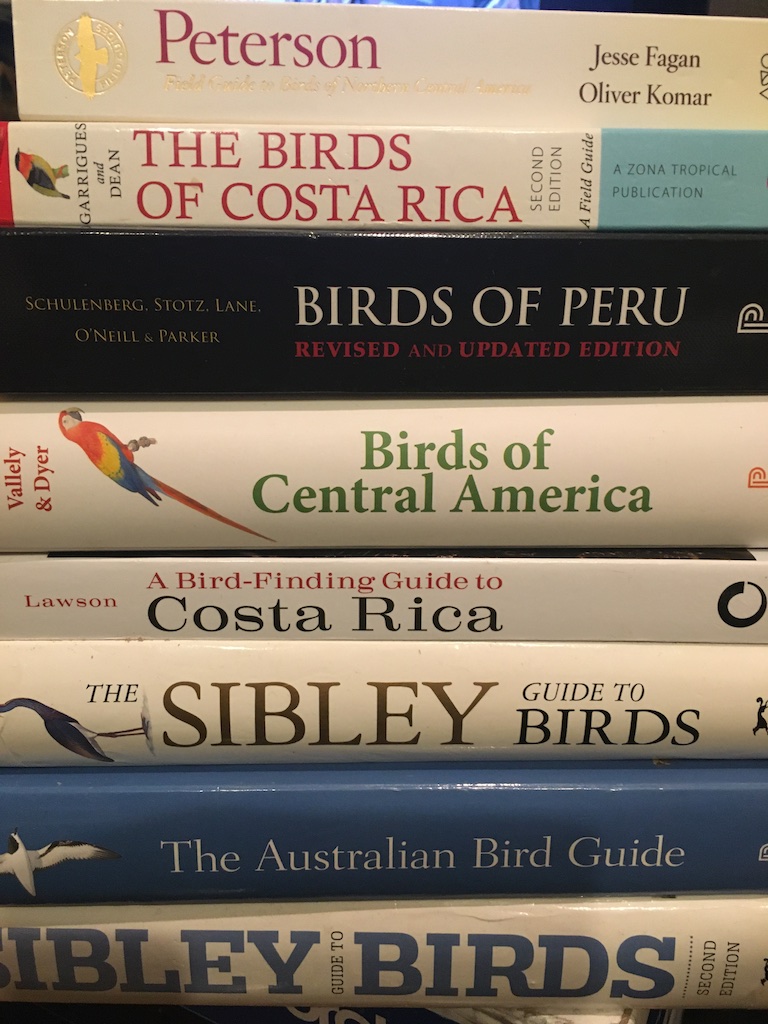
At home we looked up field guides to the birds of Peru, and got a used copy of Princeton Field Guides Birds of Peru which we read through in prep for the trip.
An important book for this trip was a Latin American Spanish phrasebook to use for prep and take on the trip. I’d visited Costa Rica and we managed to drive all over the country in a 4×4 and we were fine, but I am definitely not fluent. At one point in Costa Rica we managed to get a rented 4×4 stuck in the mud, I talked to some locals about our problem and got a solution involving a tractor pulling us free worked out, but I didn’t know the word for mud (which I eventually looked up – “barro”).
We decided we wanted a paper book for this trip. We were in areas with very limited network, so no online tools were reliable. We ultimately bought the Lonely Planet Latin American Spanish Phrasebook and Dictionary online and that thing has been worth it’s weight in gold.
The book’s good – helped sort out the important vocab quickly, offer phrased (of varying utility, but many helpful), and it has a small but nice dictionary in the back.
I read and reviewed relevant sections of the book before the trip for prep, on air/bus/train travel, hotels, restaurants and other utility vocab./phrases to work into working memory. I reviewed before the trip and also during transit times or other down times. I hadn’t spoken Spanish in a couple years and was far from fluent then, so I had to work a lot in. I read bits and pieces of the dictionary as well just to look things up when I wondered about vocab. The book worked well for this.
I studied four years of Spanish in high school, and in college studied Greek and Latin with bits of French and German. This kind of background meant that I have a fair proficiency with reading Spanish, but learning to understand spoken Spanish by ear is really hard.
Part of my prep for ear training was listening to Latin music, and listening to/watching Spanish language media. Before the trip I watched a fair amount of Maria La Del Barrio with Spanish subtitles. This helped catch up on vocab more and work on listening skills. Also on the bus from Pisco to Lima Wallace and Gromit: Curse of the Were-Rabbit came on with Spanish voice acting and Spanish subtitles. That turned out to be a great show for immersion. (Iron Man II which was on earlier was less effective). I also listened to Latin music, though it’s likely Tito Puente’s latin jazz instrumentals didn’t really solidify my Spanish much.
Since the trip we watched The Muppets in Spanish which was great, and also interesting since the Latin American Spanish voiceover and the Latin American Spanish subtitles didn’t match.
I did Duolingo every day for a couple months leading up to the trip to keep basic language exercises running and help good enough vobab in working memory. It’s probably not the best language teaching app, but it’s adequate and helpful for reinforcing core vocab and reinforcing basic idioms. Since then I’ve kept it up and daily practice really is key.
Immersion really is the a great way to exercise auditory processing of a language, so this trip was also an opportunity to work on improving Spanish listening/comprehension skills. During the time spent in Peru I practiced where I could, and the immersion really did help a lot to reinforce learning. On the ride to the airport on the way home from Peru I chatted with the driver about the things we’d done like seeing penguins and flamingos on the coast, and how I really liked meeting people who spoke Quechua and he told me about the protections of pre-hispanic languages and cultures in their constitution, and we talked a bit about Aymara and Quechua.
My Spanish skills improved, though I was motivated to improve and thus spent time studying in prep. Learning some Spanish before visiting a Latin American country helps ease getting through customs/airports/train stations, etc. It’s also helpful in getting better food, and helps for finding interesting spots to visit on the ground. It’s really nice to be able to just chat with locals about birds and wildlife, it’s pretty common to find people who really do love seeing their local wildlife, and it’s honestly just nice to be able to tell them in their language how interesting/wonderful/important you find the local ecosystems and wildlife. You also manage better when visiting the little produce stores and so on. If you want to improve in a language, motivation really is important since you need motivation to keep up a practice regimen. The chances of getting really good food, seeing interesting birds/wildlife are easy motivators for me.
You can learn things about areas to look around, get pointers to interesting birds, etc. You also can save money, since stuff catering to anglo tourists can be priced higher than things marketed to Latin America, esp lodging. It also really is interesting when you get the chance to talk to people who live in other countries.
 The Nature Bloggist